

Office Desk Buying Guide
Buying an office desk that fits your space, supports your posture, and matches your workflow is difficult. The right desk balances surface area, shape, material, and ergonomics with your daily tasks and room dimensions. This guide walks you through every decision point. You will learn what desk size, shape, height, material, and features to choose before you buy.
Key Highlights
- Standard office desks measure 30 inches high, 48 to 72 inches wide, and 24 to 36 inches deep for most adults.
- Rectangular desks suit small rooms, L-shaped desks fit corners, and U-shaped desks work for executives with paperwork-heavy roles.
- Laminate desks cost less and resist scratches, while solid wood desks last longer and signal a premium executive aesthetic.
- Height-adjustable desks reduce back strain by letting you alternate between sitting and standing every 30 to 60 minutes.
How to Choose an Office Desk
Choosing an office desk follows a clear sequence. You measure the room, set a budget, pick a shape, select a material, confirm ergonomic dimensions, plan for storage, and verify cable management. Each step eliminates options that will not work for your space or job. Skipping any step often leads to returns or chronic discomfort within weeks.
Measure Your Office Space
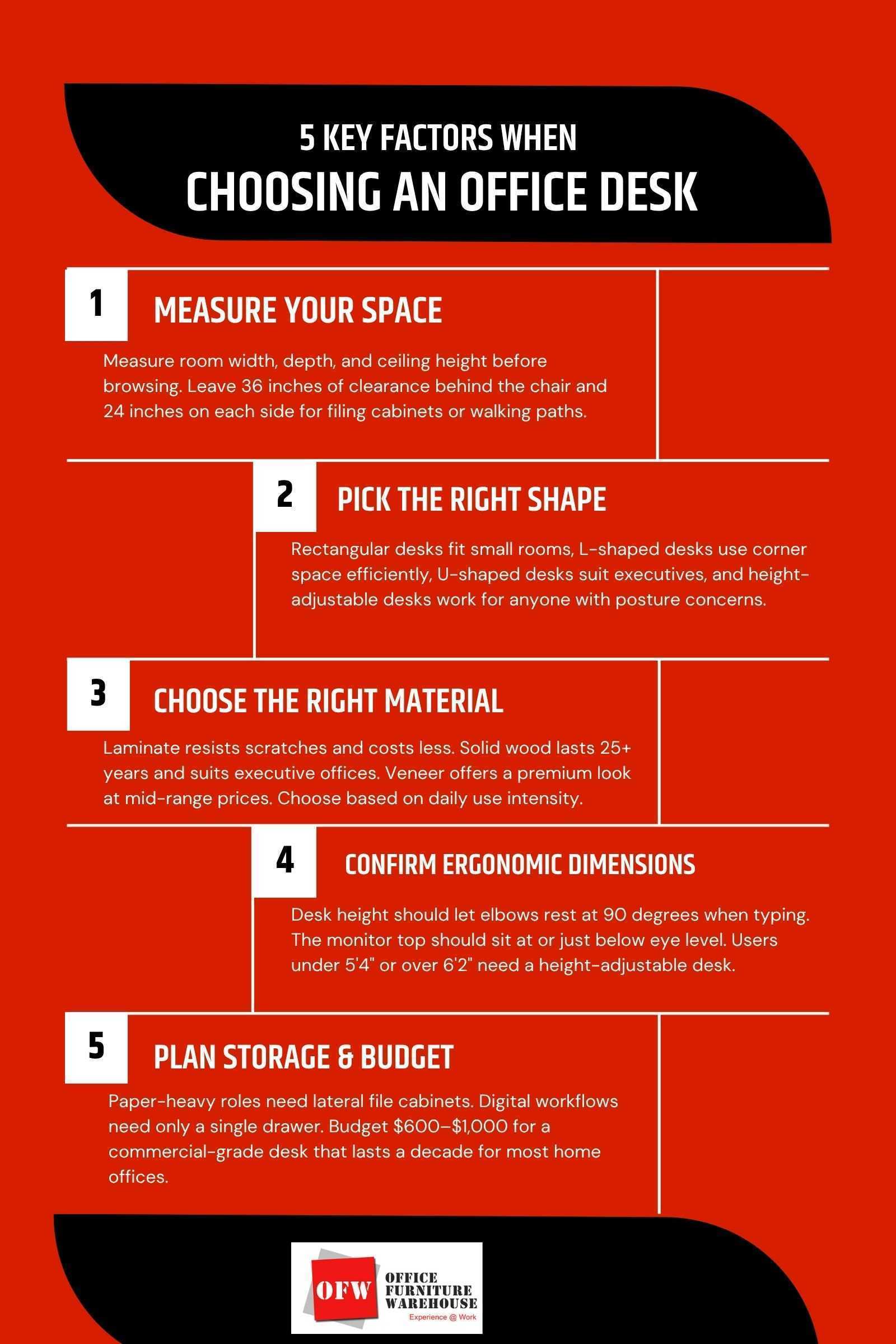
Measure the room width, depth, and ceiling height before browsing desks. Note the location of outlets, windows, doors, and HVAC vents. Leave 36 inches of clearance behind the chair for movement. Allow 24 inches on each side of the desk for filing cabinets, printers, or walking paths.
Set a Realistic Budget
Office desk prices range from $150 for compact laminate models to $3,000+ for solid wood executive desks. Mid-range commercial-grade desks fall between $500 and $1,200. Budget separately for an ergonomic chair, monitor arm, and lighting. A desk without a supportive chair causes the same back pain a cheap desk does.
Pick the Right Desk Shape
The desk shape determines how much surface area you get and how the desk fits the room. Match the shape to your workflow first, then to the room.
Select a Desk Material
Material affects durability, weight, price, and aesthetics. Laminate, wood veneer, solid wood, metal, and glass each serve different use cases.
Confirm Ergonomic Dimensions
Desk height should let your elbows rest at 90 degrees when typing. The top of your monitor should sit at or just below eye level for neutral neck posture.
Plan Storage and Drawers
Decide between built-in pedestals, mobile pedestals, or separate filing cabinets. Paper-heavy roles need lateral files, while digital workflows need only a single drawer.
Check Cable and Power Management
Look for grommets, wire trays, and integrated power outlets. Hidden cables keep the surface clear and prevent tripping hazards in shared spaces.
Office Desk Dimensions and Size Guide
Standard office desk dimensions cover most adults between 5’4″ and 6’2″. Use the table below to match desk size to user height and room footprint. Most desks fix the height at 30 inches. Users under 5’4″ or over 6’2″ should pick a height-adjustable desk to set the surface to elbow level.
| Desk Size | Width | Depth | Height | Best For |
|---|---|---|---|---|
| Compact | 40 to 48 inches | 20 to 24 inches | 29 to 30 inches | Small home offices, laptops only |
| Standard | 60 inches | 30 inches | 30 inches | Single monitor, light paperwork |
| Large | 66 to 72 inches | 30 to 36 inches | 30 inches | Dual monitors, daily paperwork |
| Executive | 72 to 84 inches | 36 to 42 inches | 30 inches | Client meetings, leadership roles |
Types of Office Desks
Office desks fall into four main shape categories. Each shape solves a different combination of space and workflow needs.
Rectangular Desks
Rectangular desks offer the most flexible footprint. They fit against a wall, in the middle of a room, or as part of a workstation cluster. This shape suits writers, accountants, designers, and anyone with a single-monitor setup.
L-Shaped Desks
L-shaped desks tuck into corners and create two work zones from one footprint. One leg holds the computer, the other holds papers, reference books, or a second monitor. L-shaped desks suit hybrid workers, designers, and managers who toggle between screen work and paperwork.
U-Shaped Desks
U-shaped desks wrap three sides around the user. The configuration includes a main desk, a bridge, and a credenza for maximum surface and storage. This shape suits executives, attorneys, and finance leads who handle stacks of reference material.
Height-Adjustable Desks
Height-adjustable desks raise and lower the surface electrically or with a hand crank. Users alternate between sitting and standing throughout the day. They suit anyone with back pain, sciatica, or a desire to reduce sedentary hours.
Desk Shape Comparison Table
| Shape | Surface Area | Room Footprint | Best Use Case | Storage |
|---|---|---|---|---|
| Rectangular | Low to medium | Small | Single-task, small rooms | Add-on pedestals |
| L-shaped | High | Medium (corner) | Dual-task, hybrid work | Built-in returns |
| U-shaped | Highest | Large | Executives, paperwork | Full credenza |
| Height-adjustable | Medium | Small to medium | Ergonomic focus | Limited, add mobile pedestal |
Office Desk Materials
Desk material drives durability, weight, and price. Choose based on daily use intensity and the look you want for the room.
Laminate
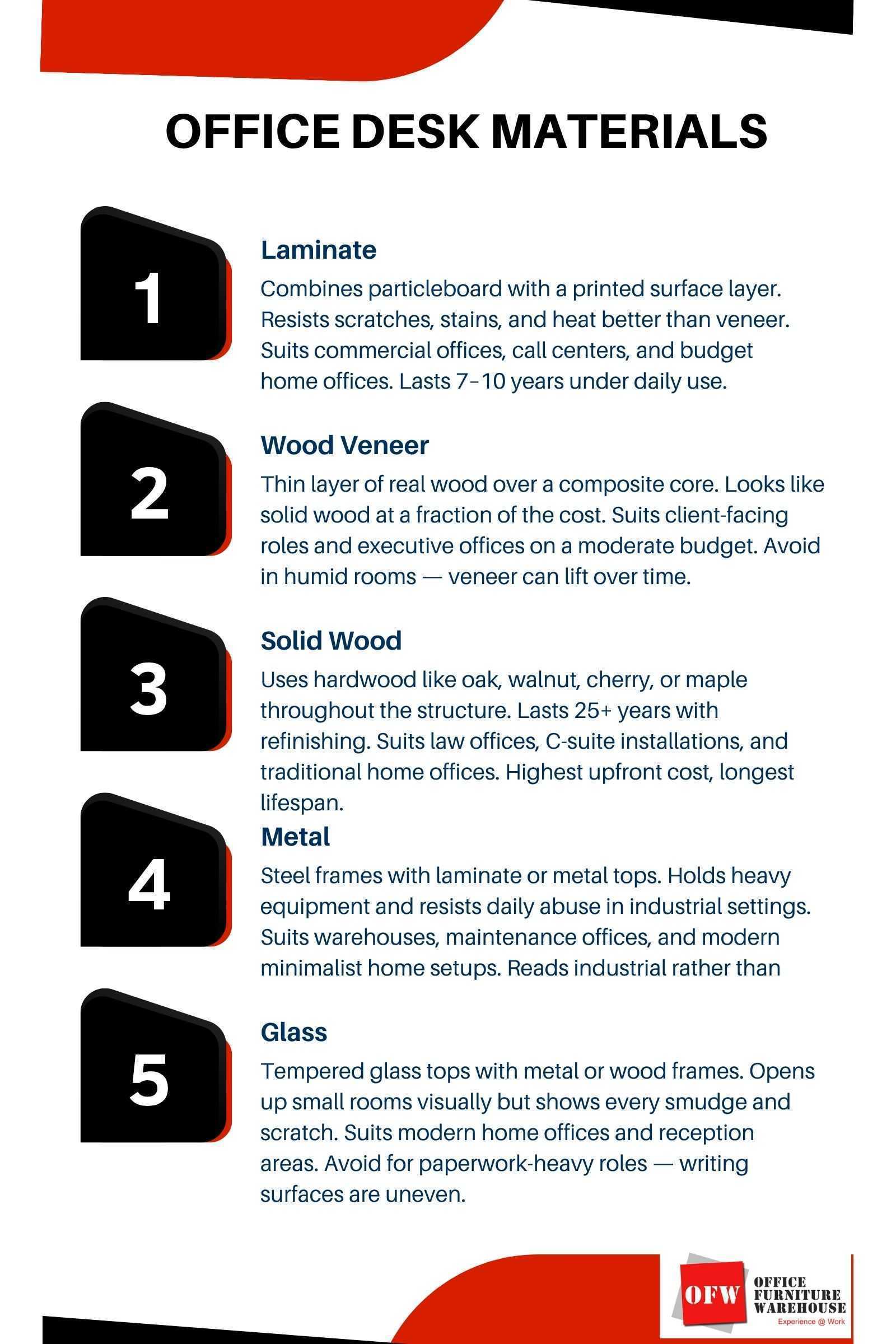
Laminate desks combine particleboard with a printed surface layer. They resist scratches, stains, and heat better than veneer. Laminate suits commercial offices, call centers, and budget home offices. The surface lasts 7 to 10 years under daily use.
Wood Veneer
Wood veneer applies a thin layer of real wood over a composite core. The finish looks like solid wood at a fraction of the cost. Veneer suits client-facing roles and executive offices on a moderate budget. Avoid in humid rooms because the veneer can lift over time.
Solid Wood
Solid wood desks use hardwood like oak, walnut, cherry, or maple throughout the structure. They last 25+ years with refinishing. Solid wood suits law offices, C-suite installations, and traditional home offices.
Metal
Metal desks use steel frames with laminate or metal tops. They hold heavy equipment and resist daily abuse in industrial settings. Metal suits warehouses, maintenance offices, and modern minimalist home setups. The look reads industrial rather than traditional.
Glass
Glass desks pair tempered glass tops with metal or wood frames. They open up small rooms visually but show every smudge and scratch. Glass suits modern home offices and reception areas. Avoid for paperwork-heavy roles because writing surfaces are uneven.
Material Comparison Table
| Material | Price Range | Durability | Maintenance | Best Aesthetic |
|---|---|---|---|---|
| Laminate | $ | 7 to 10 years | Wipe clean | Modern, commercial |
| Wood veneer | $$ | 10 to 15 years | Wood polish | Traditional, executive |
| Solid wood | $$$$ | 25+ years | Refinish every 10 years | Classic, premium |
| Metal | $$ | 20+ years | Wipe, touch-up paint | Industrial, modern |
| Glass | $$ | 10+ years | Daily glass cleaner | Contemporary, minimalist |
Ergonomic Specifications That Prevent Back Pain
Ergonomic desk specifications align your spine, shoulders, and wrists in neutral positions. Wrong specs cause neck pain, wrist strain, and lower back fatigue within months. Set the desk height so your forearms stay parallel to the floor. Position the monitor 20 to 30 inches from your eyes with the top edge at brow level.
Standard Ergonomic Targets
- Desk height: 28 to 30 inches for users 5’8″ to 6’0″
- Knee clearance: 24 inches wide, 18 inches deep, 27 inches tall
- Monitor distance: 20 to 30 inches from eyes
- Keyboard tray: 1 to 2 inches below desk surface
- Chair height: adjusted so feet rest flat on the floor
An adjustable-height desk solves sizing problems for shared workstations and households with multiple users.
Office Desk Features Worth Paying For
Certain desk features save time and reduce clutter daily. Skip others that look useful but rarely get used.
Worth the Investment
- Grommets and cable trays for monitor and power cords
- Built-in USB and AC outlets at the desk edge
- Locking drawers for sensitive documents
- Anti-tip safety brackets for L and U shapes
- Modesty panels for client-facing roles
Often Overpaid For
- Built-in lamps with low color rendering
- Hutches that block sight lines and reduce natural light
- Pull-out keyboard trays in fixed-height desks
- Decorative inlays that wear unevenly
Office Desk Buying Guide by Room Type
The room itself narrows your shape and size options. Match the desk to the space before falling in love with a style.
Home Office
A home office typically measures 80 to 150 square feet. A 60-inch rectangular or compact L-shaped desk fits most rooms with space for a chair, filing cabinet, and bookshelf.
Small Office or Cubicle
Cubicles and small offices under 60 square feet need compact desks 40 to 48 inches wide. Wall-mounted or fold-down desks work when floor space disappears.
Executive Office
Executive offices over 200 square feet support U-shaped desks with credenzas. Solid wood or premium veneer signals authority during client meetings.
Open Plan or Bench Seating
Open plans use modular benching desks that share power, data, and dividers across rows. Each user gets 60 to 72 inches of width with a privacy screen.
How Much Should You Spend on an Office Desk?
Office desk pricing follows material and shape closely. Use the brackets below as a planning baseline.Spending $600 to $1,000 gets a commercial-grade desk that lasts a decade for most home and small business users.
| Budget Tier | Price Range | What You Get |
|---|---|---|
| Entry | $150 to $400 | Compact laminate, single drawer, basic frame |
| Mid-range | $400 to $1,200 | Standard laminate or veneer, pedestals, cable management |
| Premium | $1,200 to $3,000 | Solid wood veneer, L or U shape, integrated power |
| Executive | $3,000+ | Solid hardwood, custom finishes, full credenza |
Common Mistakes to Avoid When Buying an Office Desk
- Ordering before measuring the room and doorways
- Choosing a desk taller than 30 inches for users under 5’8″
- Picking glass for a paperwork-heavy role
- Skipping cable management and regretting it within a week
- Buying a U-shaped desk for a room under 120 square feet
- Forgetting to budget for a chair and monitor arm