

Modular Office Furniture Complete Guide
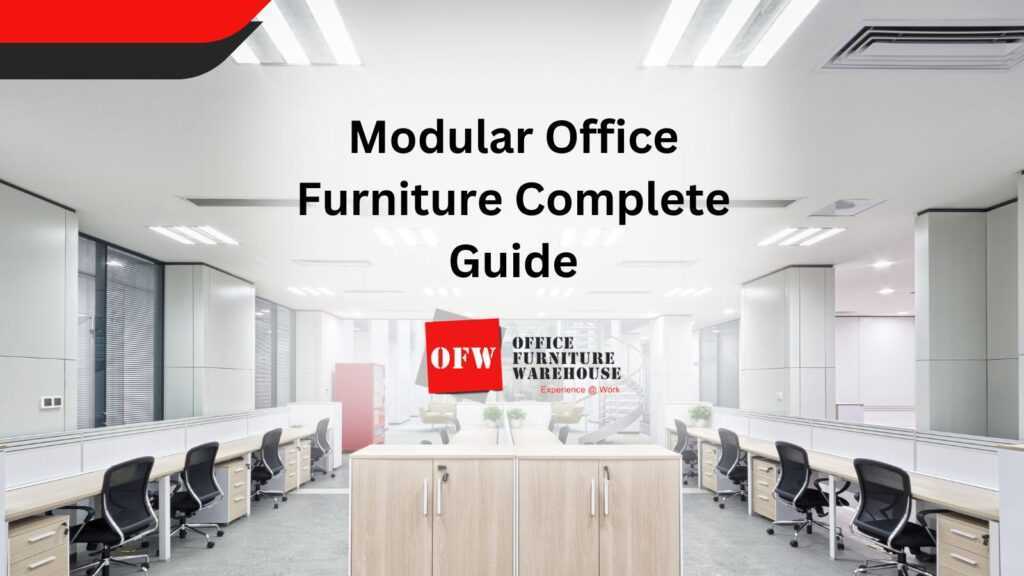
Modular office furniture is a component-based system of interchangeable desks, panels, storage, and seating that you can assemble, disassemble, and reconfigure to match evolving workspace needs. It replaces fixed, single-purpose pieces with a kit of parts. This guide explains how modular office furniture works, its core benefits, the main system types, and how it compares to traditional setups.
Key Highlights
- Modular office furniture uses interchangeable components like desks, panels, and storage that snap together for fast reconfiguration without renovation.
- The system delivers four core benefits: flexibility, space optimization, long-term cost savings, and reduced relocation expenses for growing companies.
- Core components include modular workstations, panel systems, benching systems, modular desks, storage units, and modular lounge seating.
- Compared to traditional furniture, modular systems cut waste, support hybrid layouts, and extend asset life through reuse of individual parts.
- Costs typically range from $800 to $4,000 per workstation depending on brand, finish, panel height, and integrated technology.
What Is Modular Office Furniture?
Modular office furniture is a coordinated system of standardized, interchangeable components designed to be assembled and reconfigured easily. Each piece connects to others through shared dimensions and fittings. The system functions as a flexible toolkit instead of a fixed installation. Companies start with a base configuration and expand, contract, or rearrange the layout as headcount and workflows change.
Components share finishes, panel heights, and connector types. Modular systems typically include workstations, partitions, desks, storage units, and seating that follow a unified design language. This consistency lets teams scale without visual mismatch or compatibility issues across departments and locations.
How Modular Office Furniture Works
Modular furniture works on the principle of component-based assembly. Manufacturers produce standardized parts in fixed dimensions, which lets buyers combine them into custom layouts using basic hardware and connector kits. Each component, whether a desk, panel, or storage cube, attaches to adjacent pieces through universal fittings. Teams can add a workstation, swap a panel height, or convert a private office into an open bench setup in hours instead of weeks.
Benefits of Modular Office Furniture
Modular office furniture delivers measurable advantages across cost, space, scalability, and sustainability. Below are the six benefits that matter most for growing businesses.
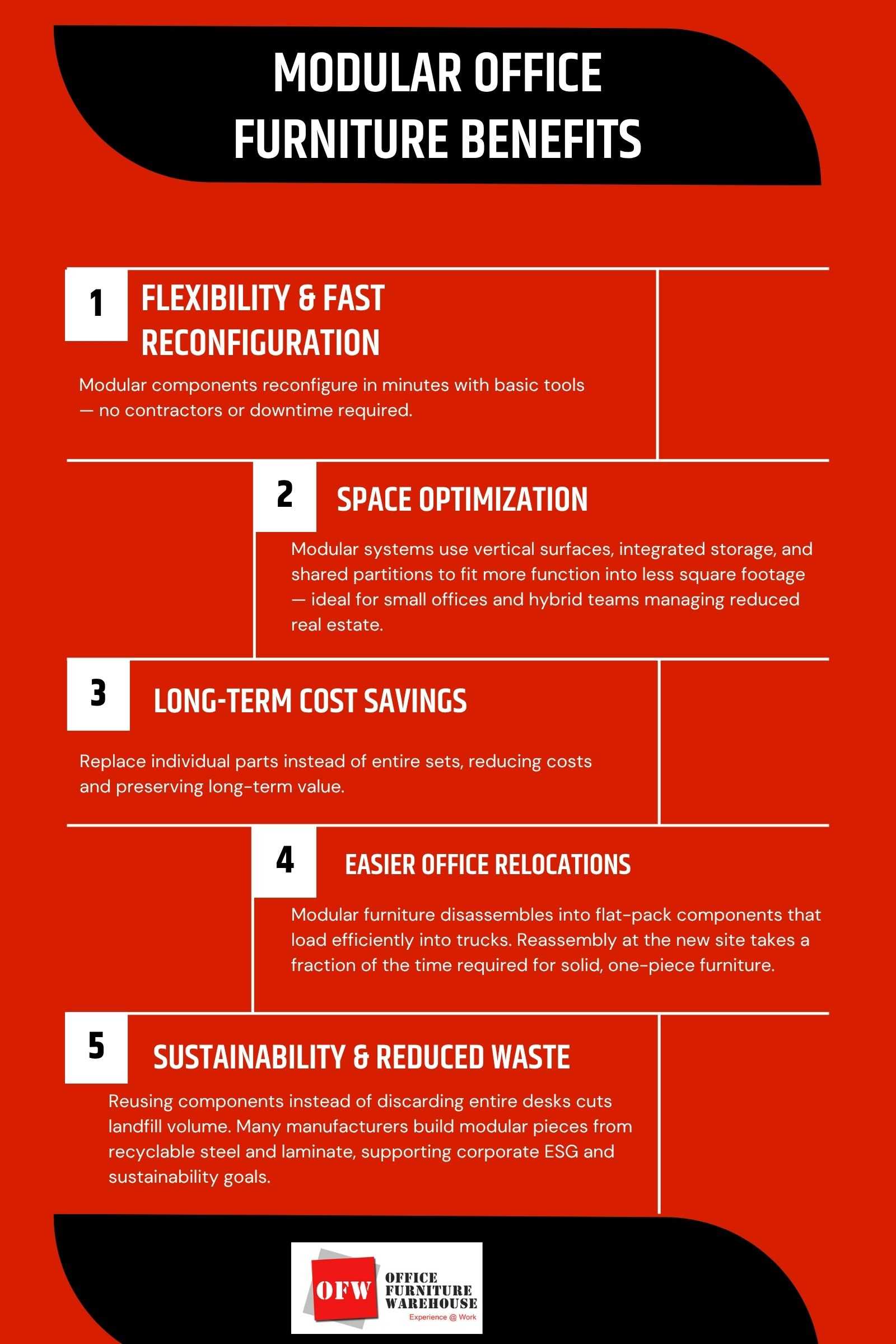
1. Flexibility and Fast Reconfiguration
Modular components disassemble and reassemble in minutes using basic tools. Teams can shift from open collaboration zones to private focus areas without hiring contractors or pausing operations during the transition.
2. Space Optimization
Modular systems use vertical surfaces, integrated storage, and shared partitions to fit more function into less square footage. This matters for small offices and hybrid teams managing reduced real estate footprints.
3. Long-Term Cost Savings
Buyers replace individual components, not full sets, when something wears out. Adding seats during growth costs a fraction of buying matching traditional desks, and resale value stays higher because parts remain compatible across years.
4. Easier Office Relocations
Modular furniture disassembles into flat-pack components that load efficiently into trucks. Reassembly at the new site takes a fraction of the time required for solid, one-piece furniture, lowering moving costs significantly.
5. Sustainability and Reduced Waste
Reusing components instead of discarding entire desks cuts landfill volume. Many manufacturers now build modular pieces from recyclable steel and laminate, supporting corporate ESG and sustainability reporting goals.
6. Brand and Aesthetic Consistency
Shared finishes, fabrics, and dimensions create a cohesive look across departments and floors. New components match existing ones, which preserves visual identity even as the workspace grows or shifts location.
Core Components of a Modular Office Furniture System
A complete modular system combines several component categories. Each category serves a specific workspace function while sharing connectors and finishes with the others.
| Component | Primary Function | Common Configurations |
|---|---|---|
| Modular workstations | Individual or shared work surfaces | Linear, L-shape, U-shape, cluster of four or six |
| Panel systems | Privacy and acoustic separation | 47 inch, 53 inch, 67 inch, glass-topped variants |
| Benching systems | Open collaborative seating | Back-to-back rows, side-by-side spines |
| Modular desks | Standalone or grouped work surfaces | Straight, corner, height-adjustable |
| Storage units | Filing, supplies, personal items | Pedestals, overheads, lateral files, lockers |
| Architectural walls | Permanent-feel room division | Full-height demountable walls, glass fronts |
| Lounge seating | Soft, collaborative meeting areas | Modular sofas, booths, ottomans |
Browse the full ranges of modular office desks, modular architectural walls, and modular lounge seating for active project planning.
Modular vs. Traditional Office Furniture
Buyers often compare modular systems with traditional office furniture before committing. The table below highlights the differences across the factors that matter most for procurement decisions.
| Factor | Modular Office Furniture | Traditional Office Furniture |
|---|---|---|
| Upfront cost | Moderate, scales with size | Lower per piece, higher in volume |
| Reconfiguration | Fast, in-house, low disruption | Difficult, often requires replacement |
| Scalability | Adds matching components anytime | Limited by discontinued designs |
| Relocation cost | Low, flat-packs easily | High, bulky and hard to disassemble |
| Lifespan | 15 plus years with part swaps | 7 to 10 years before full replacement |
| Customization | High via component mixing | Low, fixed at purchase |
| Sustainability | High, reusable parts | Lower, often discarded whole |
Traditional furniture suits offices with stable headcount and permanent floor plans. Modular systems suit growing teams, hybrid models, and tenants on shorter leases.
How Much Does Modular Office Furniture Cost?
Modular office furniture costs $800 to $4,000 per workstation in most commercial projects. Pricing depends on brand, panel height, work surface material, integrated power, and finish selections. Entry-level benching configurations from value brands run around $800 to $1,500 per seat.
Mid-tier systems with 53 inch panels, laminate surfaces, and storage pedestals usually fall between $1,800 and $2,800 per seat. Premium systems with glass panels, integrated power, height-adjustable desks, and designer finishes can exceed $4,000 per workstation. Pre-owned modular furniture often reduces these figures by 40 to 60 percent without sacrificing function.
Who Should Buy Modular Office Furniture?
Modular office furniture fits companies expecting change. The buyer profiles below typically see the strongest return on the initial investment.
- Growing startups planning to double headcount within two to three years
- Hybrid teams rotating between in-office and remote schedules weekly
- Tenants on shorter commercial leases who need portable assets
- Multi-location businesses needing consistent brand expression across sites
- Sustainability-focused organizations tracking waste reduction and ESG goals
Companies with stable headcount and permanent leases may find traditional furniture more cost-effective upfront. Modular systems return their premium through reconfiguration savings over time.
How long does modular office furniture last?
Quality modular office furniture lasts 15 to 20 years when components are maintained and selectively replaced. Steel frames, panels, and connectors typically outlast work surfaces and fabrics. Buyers extend lifespan further by swapping worn parts instead of replacing full stations, which preserves the original investment over multiple decades.
Can modular office furniture work in small offices?
Yes, modular office furniture works exceptionally well in small offices because components use vertical space, integrate storage, and share panels between users. Compact benching systems and slim partitions maximize usable square footage. Small offices often benefit more from modular flexibility than large enterprises, since every square foot carries higher functional importance.
Final Thoughts
Modular office furniture turns the workspace into a flexible asset that grows with the business. The component-based approach reduces waste, lowers long-term cost, and supports the hybrid models most companies now operate. Start with a clear headcount projection, define activity zones, and choose a finish family you can extend over time. Selecting the right system upfront pays back across every future reconfiguration, relocation, and expansion.